Betjili slots and crash games — the two numbers worth understanding
Return-to-player and volatility describe almost everything about how a slot will behave. Neither tells you whether you will win tonight, and understanding why is the most useful thing on this page.
Affiliate link · 18+ · Gambling is not a source of income
Return to player, honestly described
A slot's RTP is the proportion of all money staked that the game returns as winnings over an enormous number of spins. A 96% RTP means that across millions of spins, the game pays back ৳96 for every ৳100 staked. The remaining ৳4 is the house edge.
Two things people misread. First, it is a long-run average across all players, not a promise about your session — a hundred spins tells you essentially nothing, and the figure only becomes reliable at scales no individual reaches. Second, it is calculated on total turnover, not on deposits. If you deposit ৳1,000 and cycle it through the game ten times, you have staked ৳10,000, and the 4% applies to that: about ৳400, not ৳40.
That second point is the one that surprises people who "only deposited a thousand". The edge is charged on every spin, and recycling winnings back into the game means paying it again.

Volatility, which matters more day to day
| Low volatility | High volatility | |
|---|---|---|
| Win frequency | Often, small amounts | Rarely |
| Win size | Modest | Occasionally very large |
| Session feel | Balance drifts slowly | Long dry runs, sharp spikes |
| Bankroll needed | Smaller | Much larger to survive the dry runs |
| Same RTP? | Yes — two games at 96% can feel completely different | |
This is why "which slot pays best" has no answer. A high-volatility game with the same RTP as a low-volatility one will empty a small balance faster, not because it pays less overall but because the dry stretches are longer than a small bankroll survives.
What does not work
- A game being "due". Every spin is independent. A slot that has not paid in two hundred spins is exactly as likely to pay on the next one as it was at the start.
- Changing stake size to trigger a bonus round. The mechanics do not track your betting pattern.
- Time of day, or switching games. Neither affects a random number generator.
- Autoplay strategies. They change how fast you lose, not whether.
Crash games — the curve carries no information
When a crash round opens, the game generates the multiplier at which it will stop. That value exists, fixed, before the curve starts moving. What you watch afterwards is an animation playing toward a number that was already decided.
This is not a criticism — it is how the format has to work for results to be verifiable. Reputable implementations are provably fair: a server seed is hashed and published before the round, combined with a client seed, so afterwards you can confirm nothing was altered mid-round. That verification only makes sense because the outcome is committed up front.
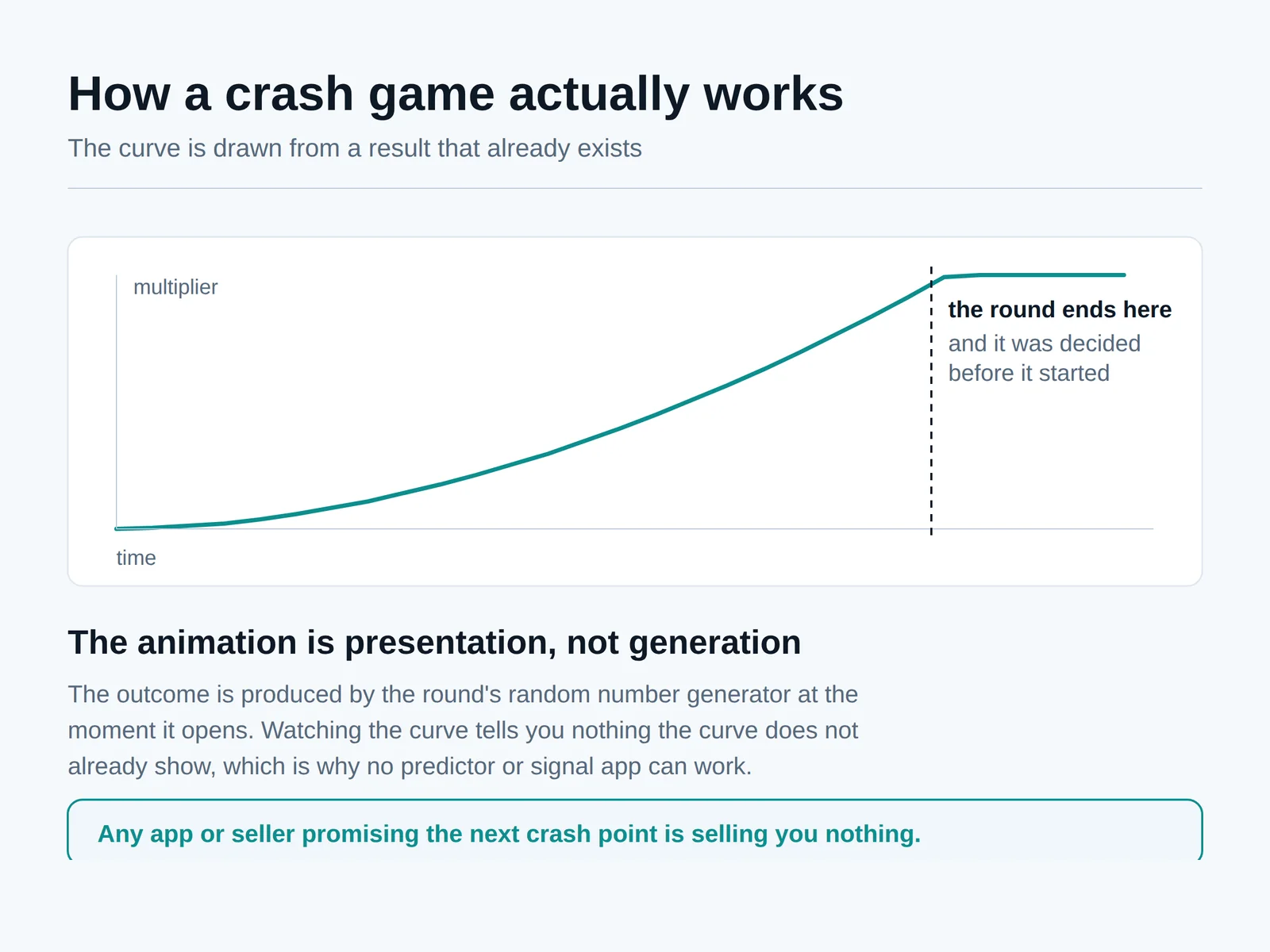
Everything follows from that. The animation contains no information about where it stops. Nothing you do during the round moves the endpoint — the only decision available is when to leave. And a predictor app would need the server-side seed, which it cannot see; anyone who had it would use it rather than sell it to you for ৳500 a month.
Auto-cashout is worth using anyway. Not because it improves the odds — it does not, at any value — but because it removes the human factor at the moment it is least reliable: hesitating for one more second after a loss and losing a round you had already won. It enforces a decision made while calm. That is a discipline tool, and a good one.
Set an auto-cashout value and a session limit before you open the game. Both are easy decisions beforehand and hard ones twenty rounds in.
Open Betjili →
Why crash deserves extra caution
Rounds last seconds. A slot has a fixed animation; a live table runs at the dealer's pace. Crash lets you re-enter immediately, hundreds of times an hour, with a visible near-miss on almost every round — you watch the multiplier sail past the number you nearly took. Speed plus constant near-misses is an unusually effective combination for producing the "one more round" state, and it is worth knowing that the design does that before you sit down to it.
Our responsible play page covers the warning signs and the limits that actually hold.
Betjili slots and crash — FAQ
Which slot providers does Betjili have?
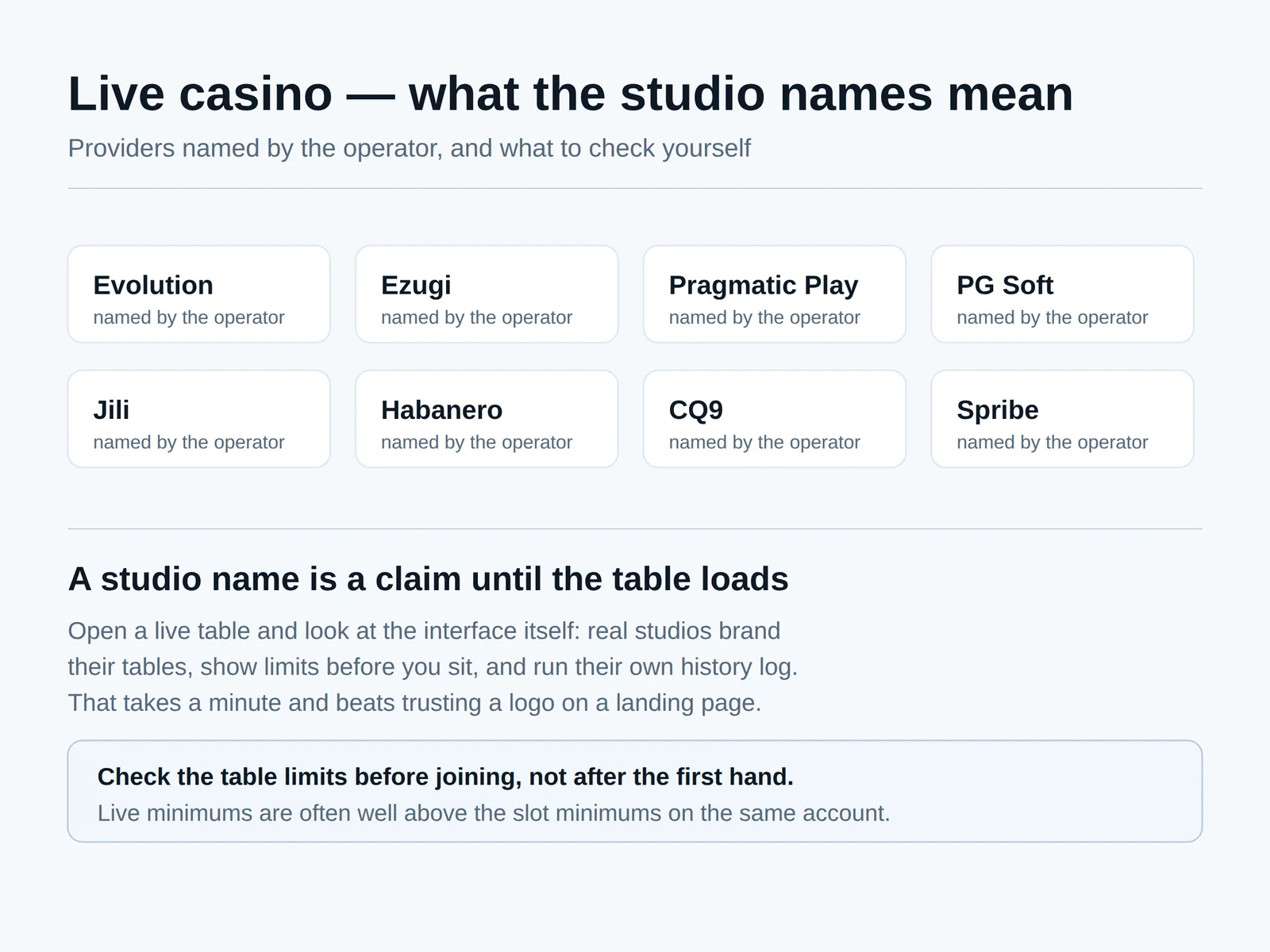
The operator names Pragmatic Play, PG Soft, Jili, NetEnt, Evolution, Spribe and others. These studios are audited independently of the operators carrying them.
What does 96% RTP mean?
Over an enormous number of spins the game returns ৳96 per ৳100 staked. It is a long-run average across all players, not a prediction about your session, and it applies to total turnover rather than to your deposit.
Which slot pays the most?
There is no such game. Two slots at the same RTP feel entirely different depending on volatility — the high-volatility one simply concentrates its returns into rarer, larger wins.
Is a slot ever "due" to pay?
No. Spins are independent. Two hundred losing spins do not make the next one more likely to win, and believing otherwise is the most expensive idea in gambling.
Do crash predictor apps work?
No. The result comes from a server-side seed the app cannot see, and the animation contains no information about where it stops. Anything sold as a predictor is a subscription scam, a credential stealer or a referral scheme.
Does auto-cashout improve my chances?
Not mathematically. It removes hesitation and reaction time, which is a genuine benefit but a behavioural one rather than a statistical one.
Why do crash games feel more compulsive than slots?
Short rounds, instant re-entry and a visible near-miss almost every time. Set limits before opening the game rather than during it.
Decide the limits before the first spin
Session length, total amount, auto-cashout value. All three are simple choices beforehand and very hard ones once a session is running.
Affiliate link · 18+ · Play responsibly